I used to get H.G. Wells and Jules Verne mixed up mainly because I had not been exposed to very much of their work and also I didn't care.
But as I got older I learned enough about the two authors to tell them apart not just by their books but by what they chose to write about. Both writers are considered (by the drifting winds that are my source of information) to be equal fathers of modern Sci Fi but aside from one being British (Wells) and one being French (Verne) there is one over-arching difference between these two men.
Jules Verne was cool; H.G. Wells not so much.
Well, that is, at least from what I've been able to tell from their choice of things to write about.
Both men are said to have predicted things in the future.
Jules Verne predicted:
Nuclear Power, Electric Submarines, Newscasts, Solar Sails, Sky Writing, GotoMeeting, Space Travel, Deep Core Drilling, Exploring Comets, Lasers, Tasers, and Space Capsule Splashdowns.
On the other hand, H.G. Wells predicted:
Martians, Moon Men, Invisibility, Mutants, Atomic bombs (in the form of balls of fire that never go out, armed by biting them with your teeth and dropped from biplanes), Heat Rays, Anti-Gravity, a World-Wide Poison Gas War, and multiple versions of Socialism that are all wonderful.
Both men are said to have predicted things in the future.
Jules Verne predicted:
Nuclear Power, Electric Submarines, Newscasts, Solar Sails, Sky Writing, GotoMeeting, Space Travel, Deep Core Drilling, Exploring Comets, Lasers, Tasers, and Space Capsule Splashdowns.
On the other hand, H.G. Wells predicted:
Martians, Moon Men, Invisibility, Mutants, Atomic bombs (in the form of balls of fire that never go out, armed by biting them with your teeth and dropped from biplanes), Heat Rays, Anti-Gravity, a World-Wide Poison Gas War, and multiple versions of Socialism that are all wonderful.
The most popular books by these two men tell me the most about their world views:
Jules Verne's 20,000 Leagues Under the Sea has been heavily adapted by Hollywood, but the book reads like a PhD dissertation on global ocean life with about 20 pages of plot filled in to make it interesting. It is a story of a really smart guy who goes on a submarine ride with another really smart guy and they explore all of the Earth's oceans end to end while discussing life, politics and the human condition. And From the Earth to the Moon, which is arguably one of the worst movies ever to be produced by Hollywood at just about the same time as 20,000 Leagues, (the book) is genuinely hilarious and painstakingly scientifically accurate, and actually includes quite a bit of math as part of the story line. In this book, a group of people decide to go to the moon one day for one simple reason: Because they were Bored Americans. The Civil War had just ended and the members of a national "Gun Club", mostly rich industrialists who were now stuck with empty munitions factories and lots and lots of leftover gunpowder, pooled their resources and started putting together a moon mission that quickly became a national, and then worldwide fixation and succeeded in bringing everyone together in harmony after so many years of bloodshed and misery.
Hollywood dumbed this book down so much to fit the silver screen that almost nothing about the movie is like the book. In fact, the movie simply isn't the book at all. They changed the science, added a girl, and didn't understand the motivations of the main characters at all. They also removed the humor because they probably didn't even see it.
Jules Verne's 20,000 Leagues Under the Sea has been heavily adapted by Hollywood, but the book reads like a PhD dissertation on global ocean life with about 20 pages of plot filled in to make it interesting. It is a story of a really smart guy who goes on a submarine ride with another really smart guy and they explore all of the Earth's oceans end to end while discussing life, politics and the human condition. And From the Earth to the Moon, which is arguably one of the worst movies ever to be produced by Hollywood at just about the same time as 20,000 Leagues, (the book) is genuinely hilarious and painstakingly scientifically accurate, and actually includes quite a bit of math as part of the story line. In this book, a group of people decide to go to the moon one day for one simple reason: Because they were Bored Americans. The Civil War had just ended and the members of a national "Gun Club", mostly rich industrialists who were now stuck with empty munitions factories and lots and lots of leftover gunpowder, pooled their resources and started putting together a moon mission that quickly became a national, and then worldwide fixation and succeeded in bringing everyone together in harmony after so many years of bloodshed and misery.
Hollywood dumbed this book down so much to fit the silver screen that almost nothing about the movie is like the book. In fact, the movie simply isn't the book at all. They changed the science, added a girl, and didn't understand the motivations of the main characters at all. They also removed the humor because they probably didn't even see it.
It seems to me that in order to be interesting to movie-goers, Hollywood takes a lot of creative license with Verne, but not so much Wells. Hollywood understands H.G. Wells, but Hollywood just doesn't get Jules Verne. So when Hollywood makes an H.G.Wells movie, it's true to the script, but when they make a Jules Verne movie, they change the whole story. Case in point, 20,000 Leagues in which the main characters are all simply men motivated by nothing more than the desire to be independent and for the quest for knowledge. but in the movie, everyone has a problem. In the movie, it's all about the emotions, yo.
I think that Wells' stories have become so much more popular because they are much better suited to big screen with little or no adaptation as far as film-makers are concerned. I was very surprised after ACTUALLY READING War of the Worlds how much the original story is very consistent with the recent Tom Cruise movie version, which had been modified only slightly so it to relate better to a modern audience (the main character, originally childless and married, is divorced with kids who have modern kid problems, for example). In this story, as everyone knows, the planet was saved because one day the Martians, who were much more advanced than our puny backward worthless selves for us to stop, simply keeled over dead, and then everything was fine.
But in the rest of H.G. Wells' top ten hit parade, the bad guys, the antagonists, the evil force to be reckoned with, is always mankind itself, and the good guys are a small, outnumbered enlightened group of people who are the only ones who know how bad and evil man really is.
I think that Jules Verne loved life and humankind, he loved the world, and he had great hopes for the future of the world, while on the other hand H.G. Wells is just a bitter socialist who seems to consider people to be the worst thing that ever happened to the planet. The whole point of The Time Machine was not how cool it would be to have a Time Machine, rather, it is a story with a moral, which is this: H.G. Wells is the victimized Eloi. You, and everyone else, are the flesh-eating Morelocks.
If I had to boil Verne's and Wells' messages each down to single sentences, Verne would be saying "Life Is Beautiful", and Wells would be saying "You Are All Assholes".
Perhaps I'm wrong.
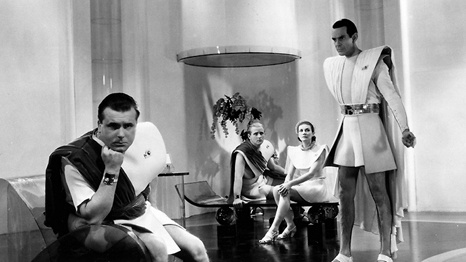
But, keeping that in mind, I now present to you, H.G. Well's 1937 Hollywood Opus, the great Christmas Blockbuster Movie, THINGS TO COME (ding dong ding dong ding dong ding dong)!
Watch it here: https://www.youtube.com/watch?v=atwfWEKz00U (and you'll quickly understand ding dong ding dong ding dong ding dong).
(As much as I am about to rag on this movie, for pure entertainment value, it is really worth watching. In fact, for reasons which exist on many strange levels inside my brain, this is one of my favorite movies. But you must also consider that my favorite movies also include Koyaanisqatsi, Alexander Nevsky, The Last Dinosaur (YOU DING DONG!), Morons From Outer Space, Eraserhead, Forbidden Planet and MANATOU! )
SO...
From the perspective of it's 1937 audience, this movie takes place in the near future, 1940 to be exact, and in England, and it is a time in which people are more interested in Christmas (stupid stupid Christmas!) than the drum beats of War that seem to be coming out of some unnamed European nation (Prolly Germany!!*). Slowly people start taking it seriously, but not soon enough to make a difference because the bad guys (Prolly Germany!!*) start bombing England.
*think about modern movies where terrorists are not muslims
So of course your first reaction is "WOW! A 1937 movie that accurately predicts the start of World War II! HG Wells is some kind of a Sorcerer!"
Well, you could say that about a few movies, such as the 1938 film specifically called "If War Comes Tomorrow" and the 1940 Heinlein story "Solution Unsatisfactory" in which WW2 starts, America joins in, then 5 years later invents the atom bomb and uses it to win the war, and then begins a cold war arms race with the Soviet Union.
Or think about all of the other material written as far back as Nostradamus that, like the proverbial broken clock, gets things right once in a while or twice a day, as the case may be, without being entirely wrong about every single thing that happens next, which is what happens in THINGS TO COME (ding dong ding dong ding dong ding dong)!
Or think about all of the other material written as far back as Nostradamus that, like the proverbial broken clock, gets things right once in a while or twice a day, as the case may be, without being entirely wrong about every single thing that happens next, which is what happens in THINGS TO COME (ding dong ding dong ding dong ding dong)!
Basically, here is what happens in H.G. Wells' prophetic vision of World War Two:
A million bi-planes engage in a poisonous gas war that destroys civilization, followed by stuff that happens in the middle part of Mel Gibson in The Road Warrior, and then there is a Zombie outbreak, and then Benevolent Socialists from Iraq force their dictatorial will on what's left of human individualism, and then a hundred years later a descendant of the leader of the Enlightened Benevolent Socialist Iraqis puts a boy and his daughter into the nose of a projectile, and with the cannon idea stolen from Jules Verne he fires it randomly into space vaguely citing "Progress" as his motivation while a smartly clothed, healthy and apparently *very ignorant* population are whipped into a frenzy by a seemingly disingenuous and sinisterly depicted opposition leader who only wants to know why he is risking lives doing something that apparently has no purpose. THE END.
A million bi-planes engage in a poisonous gas war that destroys civilization, followed by stuff that happens in the middle part of Mel Gibson in The Road Warrior, and then there is a Zombie outbreak, and then Benevolent Socialists from Iraq force their dictatorial will on what's left of human individualism, and then a hundred years later a descendant of the leader of the Enlightened Benevolent Socialist Iraqis puts a boy and his daughter into the nose of a projectile, and with the cannon idea stolen from Jules Verne he fires it randomly into space vaguely citing "Progress" as his motivation while a smartly clothed, healthy and apparently *very ignorant* population are whipped into a frenzy by a seemingly disingenuous and sinisterly depicted opposition leader who only wants to know why he is risking lives doing something that apparently has no purpose. THE END.
This isn't the first time H.G. Wells' starts off seeming to be accurately predicting something that then goes way off the rails, out into the weeds, and sinks nose first into that bottomless bog behind the Bates Motel.
In his 1913 novel The World Set Free, an intuitively predicted World War One actually kicks off right on schedule but quickly escalates into an Atomic War.
So of course your first reaction might also be WOW!
But then here's what happens:
H.G. Wells' "Atomic Bombs" are that in name only. What they really are is something that has never existed and won't ever exist because they are impossible and also stupid. They are basically a sort of napalm-filled Molotov cocktail orb that lights up and never goes out and can be manufactured by anyone and hidden inside a bail of hay.
After the interesting part is over, everyone realizes that War Bad and all of the smart people take over and decide that people are dumb and stupid and need to be dictated how things are going to be.
One bad bad bad bad man hides some Atomic Bombs in some hay because he is stupidly thinking of trying to defend his country but he is quickly murdered by the Socialist Peace Force that takes over the world. After Worldwide Socialism takes over, nobody has to work at all! So there's no crime or Anything! And all people do is Arts and Stuff! And it's Really Fantastic! And Also Your Stupid! THE END
So anyway, those are my rambling thoughts this evening about the differences between Jules Verne and HG Wells. Watch that movie.
For your Random Thought Of The Century: I wish they'd make a movie of Charles Diffin's Two Thousand Miles Below. I bet a lot of people would stare at that thing not knowing what to think! (Google it)
For your Random Thought Of The Century: I wish they'd make a movie of Charles Diffin's Two Thousand Miles Below. I bet a lot of people would stare at that thing not knowing what to think! (Google it)
-E

No comments:
Post a Comment